
Crisp and Fluffy Sourdough Focaccia
This post may contain affiliate links. For more information, please see our disclosure policy.
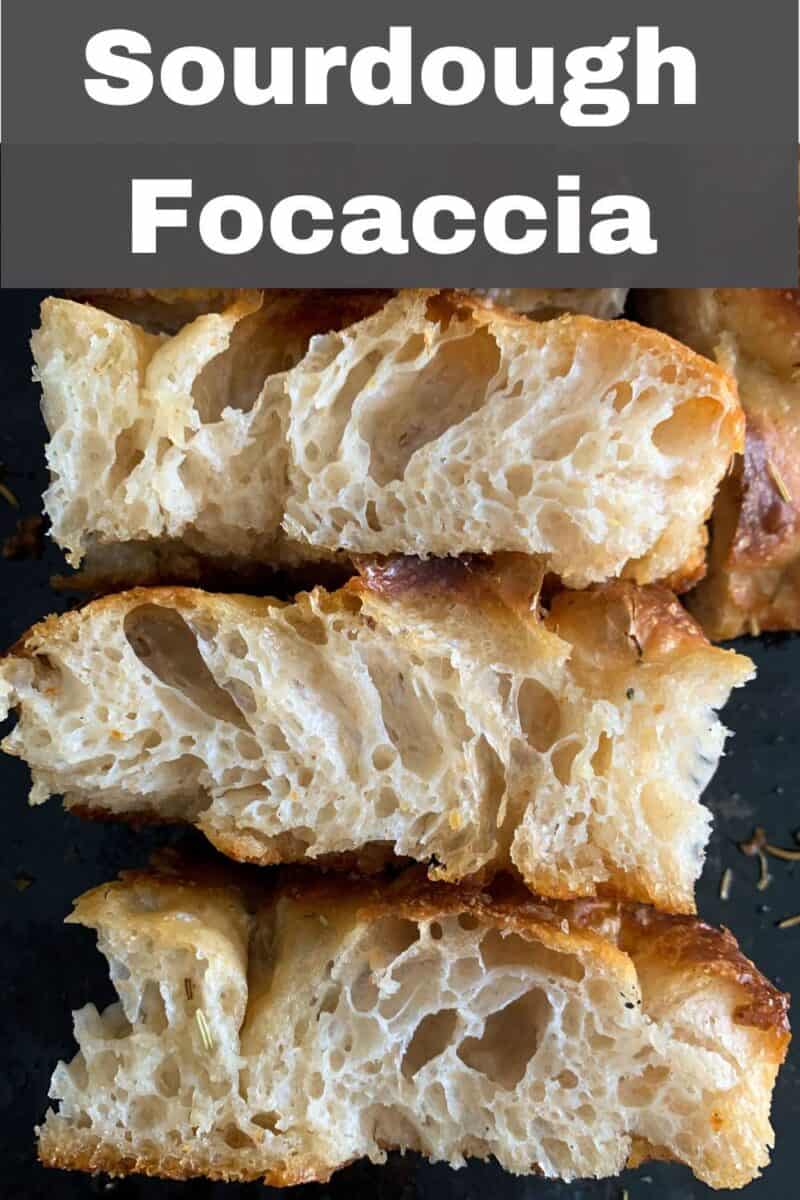
This sourdough focaccia is one of my favorite breads to make—and judging by the reviews, many readers feel the same way. Home bakers often describe it as light, fluffy, crispy, and surprisingly easy to make.
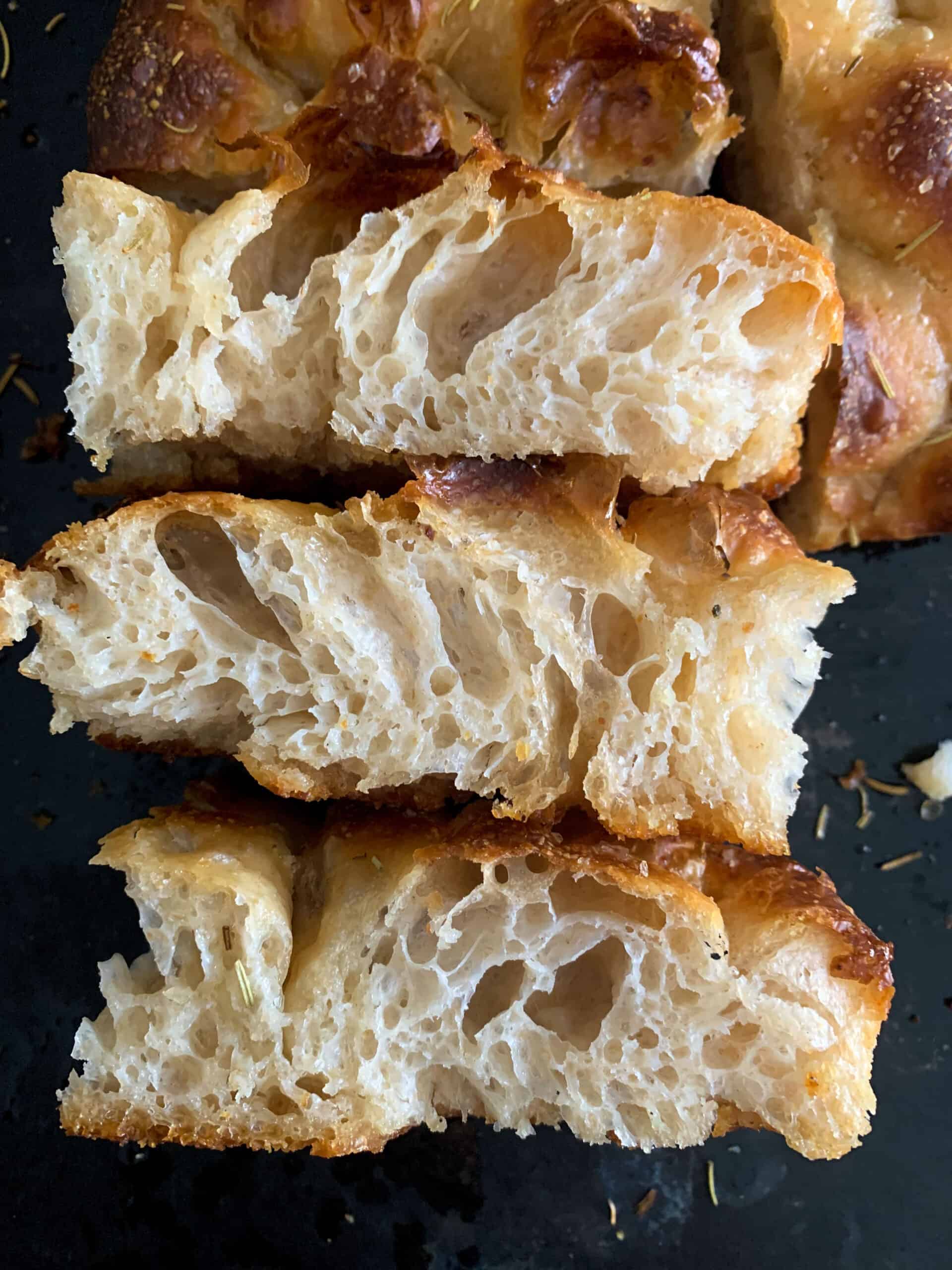
It has a light, airy interior, a crispy golden bottom, and incredible flavor from a long fermentation. Whether you keep it simple with olive oil and rosemary or load it with toppings, it’s versatile enough for sandwiches, pizza, or serving alongside dinner — it’s what I want on the table next to a pot of beef and barley stew, torn rather than sliced, for mopping the bowl. It also makes a great base for pizza-style toppings, similar to my Cast Iron Pizza or Crispy Detroit Pizza.
What Readers are Saying
⭐⭐⭐⭐⭐
“This recipe is amazing and so easy! I make it at least once a week.”
— Gina R.
Why This Recipe Works
- Long fermentation builds flavor. The sourdough starter and extended rise create a depth of flavor that can’t be achieved with a quick dough.
- High hydration creates an airy crumb. The relatively wet dough helps produce the light, open interior that great focaccia is known for.
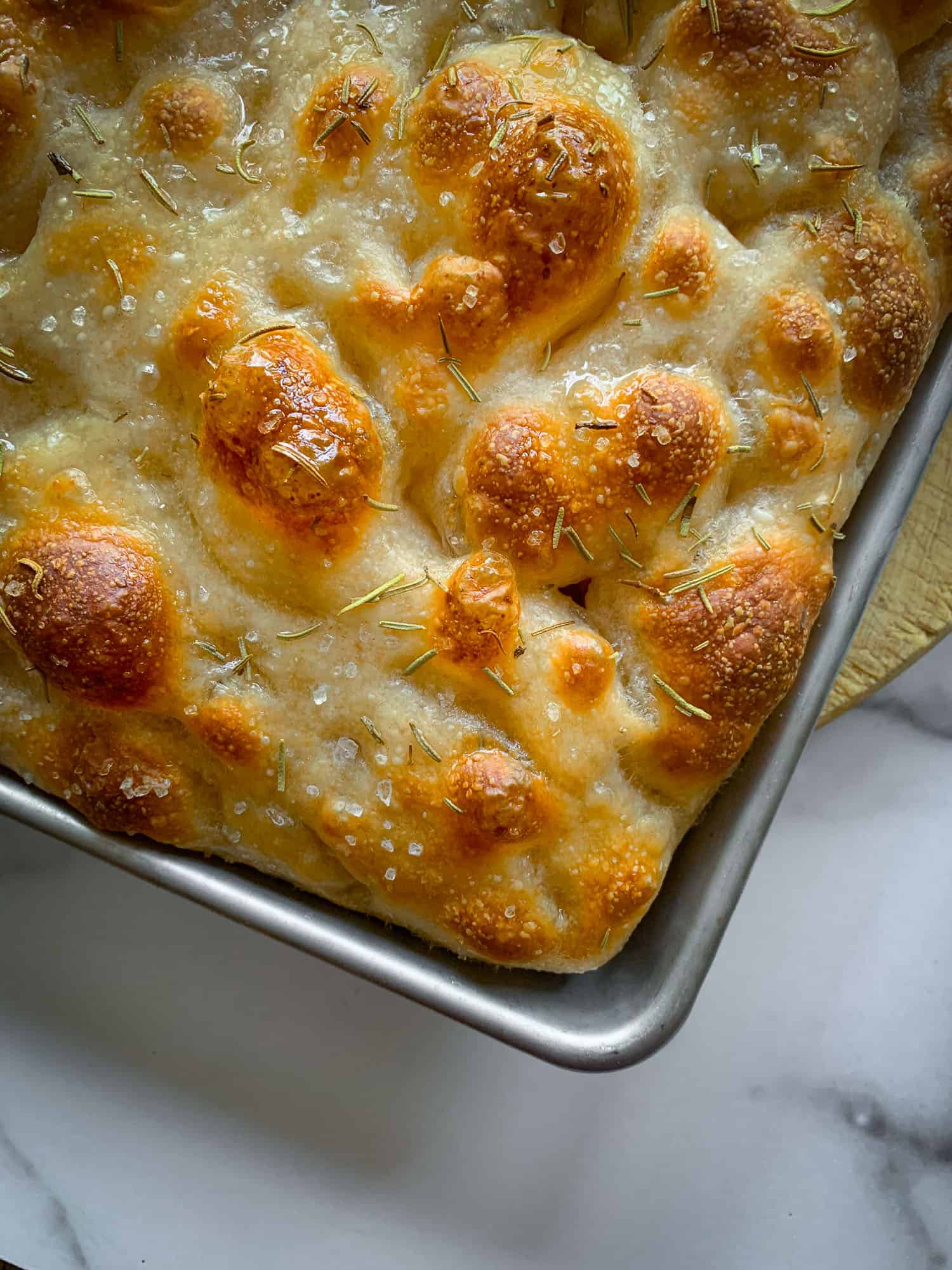
- Olive oil adds tenderness and chew. A small amount in the dough improves texture while the oil on top helps create a beautifully crisp crust.
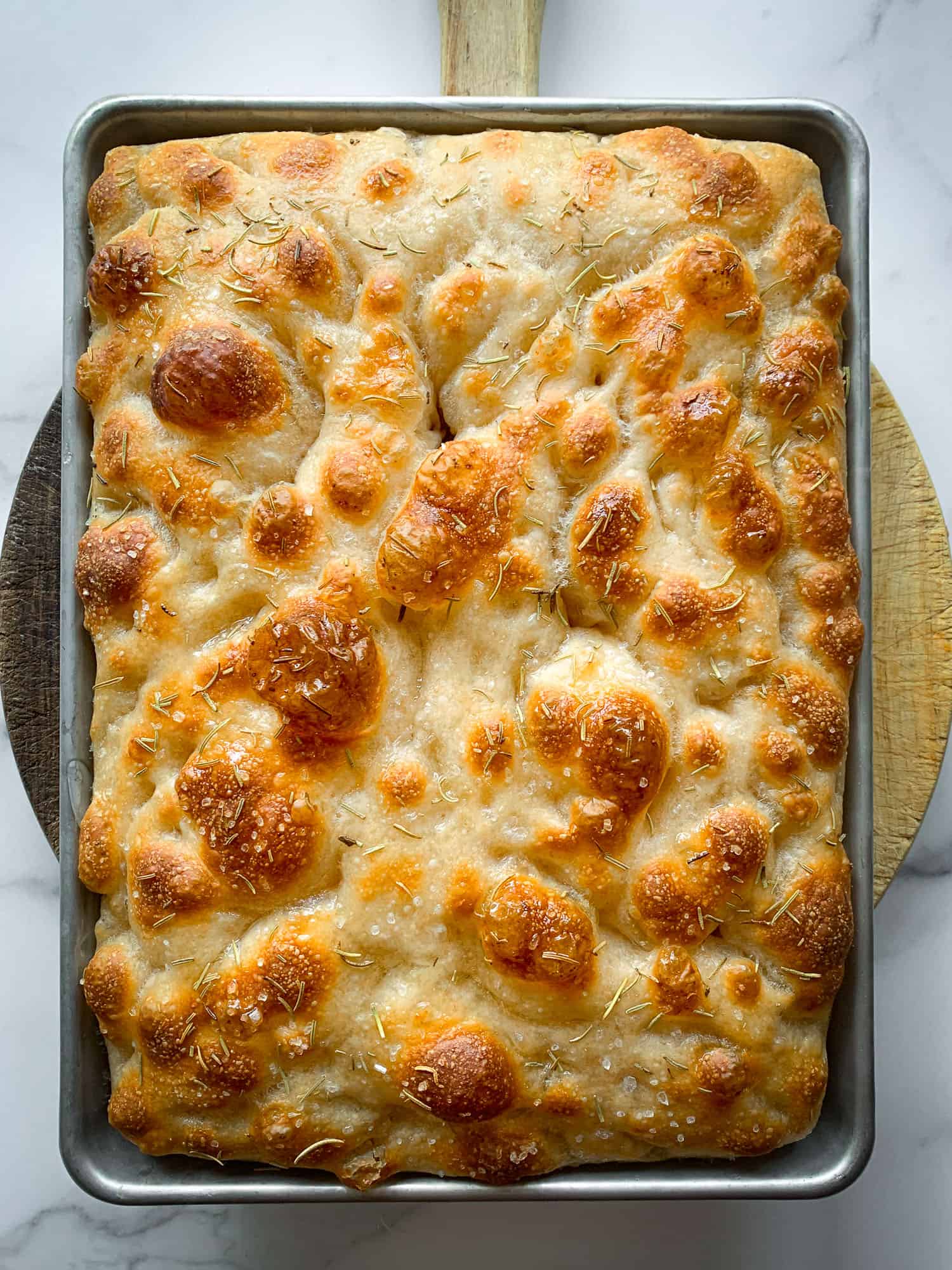
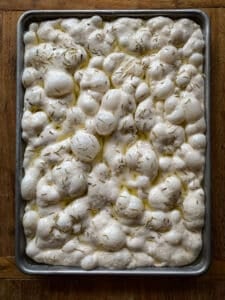
- A generous final rise creates exceptional fluffiness. The dough should look puffy and bubbly before it goes into the oven. This step is key to achieving a light interior.
- Baking on a stone or steel helps crisp the bottom. If you don’t have one, baking in the lower third of the oven produces similar results.
Ingredient Notes
Active Sourdough Starter
Use a recently fed, active starter that has doubled in size and is bubbly. This recipe relies on the starter for leavening, so sourdough discard will not provide the same rise or texture. If you’re new to working with sourdough, the Tartine Bread recipe includes additional tips for maintaining an active starter.
Bread Flour
Bread flour helps create the chewy structure and open crumb that make focaccia so appealing. While all-purpose flour can be used in a pinch, the finished bread may be slightly less chewy.
Water
This is a high-hydration dough, which contributes to the light, airy interior. The dough will feel softer and stickier than many bread doughs—that’s exactly what you want.
Olive Oil
Olive oil is used both in the dough and on top of the focaccia. It adds flavor, helps create a tender crumb, and contributes to the crispy, golden crust.
Salt
Fine sea salt, kosher salt, or table salt may be used in the dough, while flaky or coarse salt works best for the topping. The larger crystals add texture and provide little bursts of flavor in every bite.
Rosemary
Rosemary is a classic focaccia topping, but feel free to experiment with other herbs and toppings. Fresh rosemary provides the strongest flavor, but dried rosemary works well too.
Troubleshooting
Why didn’t my focaccia rise?
The most common cause is an inactive starter. Make sure your starter is recently fed, bubbly, and has doubled in size before mixing the dough. The other possibility is time or temperature. Make sure it’s in a warm spot and that enough time has passed that your dough is nice and jiggly.
Why is my dough so sticky?
This is a high-hydration dough, so it will feel much softer and stickier than many bread doughs. Resist the urge to add too much flour. Use a bit of olive oil on your hands to make handling easier.
Why is my focaccia dense?
The dough likely needed more time to rise. Before baking, it should look noticeably puffy and bubbly. This is one of the keys to making light focaccia!
Why is my focaccia sticking to the pan?
Generously oil the pan or line it with parchment paper before adding the dough. Some readers have found parchment especially helpful when using newer baking sheets. I’ve also found that focaccia releases much more easily once the bottom is deeply golden brown and fully baked. If it’s sticking around the edges, run a knife around the perimeter before removing it from the pan.
♥️ Loved this recipe? I’d be thrilled if you’d rate it ⭐️ and share your experience in the comments below! Your ratings and comments help other readers discover this recipe and keep this blog going. Did you add any special tweaks? Our community of home cooks would love to hear about it! ♥️
📖 Recipe

Thick Soft yet Crispy Sourdough Focaccia Recipe
Click the heart icon ♡ above to save a recipe. To find your saved recipes later, click the heart icon on the right side of the screen near the search icon and select My Favorites.
Equipment
- 13 x 9, baking sheet, small sheet pan, casserole dish For rectangular focaccia (line with parchment)
- 10-inch cake pans (two) For round focaccia (line with parchment paper)
- large mixing bowl
- baking stone or steel optional but highly recommended
Ingredients
- 125 grams (0.5 cups) mature sourdough starter
- 375 grams (1 2/3 cups) water
- 10 grams (2.5 tsp) sugar
- 500 grams (4 cups) bread flour
- 15 grams (1 tbsp) olive oil
- 10 grams (1 3/4 tsp) salt
For the Topping
- 1/4 cup olive oil or as needed (and to drizzle after baked)
- 1 teaspoon salt coarse flaky salt is recommended for topping but use what you have on hand.
- rosemary (fresh or dried) as needed
Instructions
To Mix the Dough
- Mix the mature sourdough starter, sugar, water and flour into a shaggy mass of dough and set aside, covered, in a warm spot for 1 hour.
- After 1 hour has passed, add the salt and olive oil to the dough.
- Mix the dough well after the salt and oil have been incorporated. I like to scrunch/pinch it in, you can use your fingers to press it in and keep folding the dough until incorporated.
First Rise of the Dough
- Place the dough in a covered container and let it rise in a warm spot for about 1½ hours. During this time, perform a set of stretch and folds every 30 minutes (about 3 sets total). Try to keep the dough in a roughly square shape—a square baking dish helps. You can also coil fold the dough, which is a simple and very effective technique.
Final Rise of the Dough
- Place the dough on your baking sheet (which must be well-oiled; update: some bakers have reported sticky, so please use parchment paper if you are not using a well-seasoned baking sheet) and allow it to rest at room temperature in a warm location for 3 to 4 hours until it's nice and bubbly. It should spread out naturally on its own, but if it needs some help, gently stretch it.
- If you are using cake pans (10-inch), divide dough in half and gently place into the cake pans. (500 grams or 1 lb of dough in each one).
- Alternatively, instead of the 3 to 4-hour warm rise, place in the refrigerator overnight (or up to 2-3 days), cover loosely with oiled plastic wrap (so it doesn't stick to the dough), and bake the next day. The focaccia can be baked directly from the refrigerated state.
Baking the Focaccia
- Preheat your oven to 450 degrees and insert a baking stone or baking steel if you have one, in the center of the oven.
- Before baking, dimple the top of the focaccia heavily by pressing your fingers in the dough and pushing all the way down to the bottom. Do this repeatedly all over the top of the focaccia.

- Top your focaccia with olive oil, salt and rosemary (or whatever topping you'd like) and bake on the baking stone or steel for about 20 minutes until golden and the bottom is crispy.
- IMPORTANT: If you don't have a baking stone or steel, ensure you are baking the focaccia in the bottom third of your oven so the bottom gets nice and crispy.
- To finish, drizzle the baked focaccia with additional olive oil l
Notes
Make Ahead
For the best flavor, refrigerate the dough overnight after shaping. It may be refrigerated for up to 2 to 3 days before baking. Bake directly from the refrigerator.Storage
Sourdough focaccia is best enjoyed the day it is baked but may be stored in an airtight container at room temperature for up to 2 days.Freezing
Freeze sliced focaccia in a freezer-safe bag for up to 3 months. For best results, flash-freeze the slices on a baking sheet first, then transfer them to a freezer bag. Alternatively, wrap individual slices in plastic wrap before freezing.Leftover Ideas
Leftover focaccia can be turned into homemade croutons or dried and processed into breadcrumbs. Nutrition calculated at 1/6 of the recipe using the 13×9 pan. May use a baking sheet or pan that is 13 x 9 (for 1000 grams/2 pounds of dough) or two cake pans (10-inch) holding 500 grams/1 pound of dough each. Note that the focaccia will be a little bit thinner using the cake pans (but also less calories per slice!). Slightly adapted from Baking Bread in the NetherlandsNutrition
Frequently Asked Questions
Can I use sourdough discard?
No. This recipe relies on an active sourdough starter for leavening. Sourdough discard will add flavor but won’t provide enough lift to create the light, airy texture this focaccia is known for. Looking for ways to use extra discard? Try my Sourdough Discard Pretzel Bites.
Can I refrigerate the dough for more than one night?
Yes. The dough may be refrigerated for up to 2 to 3 days before baking. A longer cold proof can actually improve flavor while giving you more flexibility with timing.
Do I need a baking stone or baking steel?
No. A baking stone or steel helps create a crispier bottom crust, but you can still make excellent focaccia by baking it in the lower third of your oven.
Can I use all-purpose flour instead of bread flour?
Yes, but bread flour will produce a slightly chewier texture and better structure. If using all-purpose flour, expect a slightly softer finished focaccia.
Focaccia Topping Ideas
One of my favorite things about focaccia is how versatile it is. Keep it simple with olive oil, rosemary, and flaky salt, or dress it up with vegetables, cheeses, meats, or even sweet toppings. Just be careful not to overload the dough, as too many toppings can weigh it down and affect the rise and texture.
No matter which combination you choose, finish with a drizzle of olive oil and a sprinkle of salt for the best flavor.
Classic Toppings
- Rosemary, coarse salt, and olive oil
- Roasted garlic and rosemary
- Caramelized onions
Vegetable Toppings
- Cherry tomatoes and pesto
- Tomatoes, olives, and feta
- Roasted eggplant or zucchini
Pizza-Inspired Toppings
- Pizza sauce and cheese
- Pepperoni and cheese
- Sausage and cheese
Unique Toppings
- Grapes and fennel seeds
- Olives and lemon zest
- Balsamic reduction
- Thinly sliced potatoes and rosemary
Ways to Serve Sourdough Focaccia
This sourdough focaccia is delicious on its own, but it’s also incredibly versatile. Here are some of my favorite ways to enjoy it:
- Toast leftover slices and top with ricotta, tomatoes, or roasted vegetables.
- Slice it horizontally and use it for sandwiches (homemade Italian meatballs are great here).
- Grill it for panini.
- Serve it alongside soups, stews, or chili.
- Pair it with pasta dishes instead of garlic bread.
- Add it to an antipasto or charcuterie board.
- Serve it with olive oil and balsamic vinegar for dipping.
- Use it as a base for pizza-style toppings.
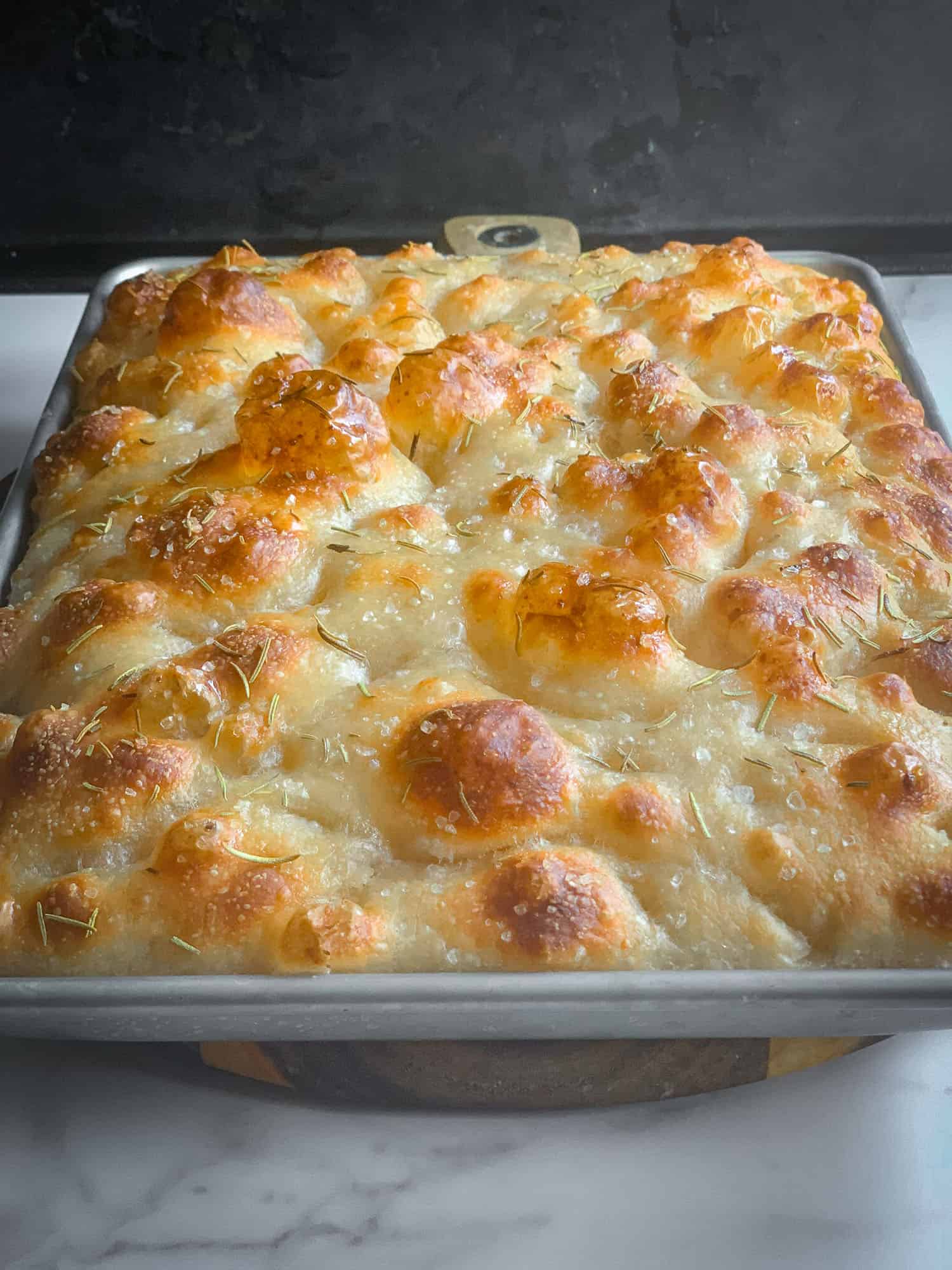
I have been trying to make the perfect sourdough focaccia and have tried a dozen recipes! This is the perfect one!!! I made it in a 10″ pan so it was 3 1/2″ tall and pillowy soft inside! I can’t wait to try different toppings!
This turned out great! I baked if off in the morning after a night in the fridge. I added a few cherry tomatoes from my garden as well. Making it again this weekend and plan to add carmelized onions.
How many times do you stretch and fold?
After mixing the dough, I would stretch and fold at 30 minutes and then again at 60 minutes and possibly again at 90 minutes if the dough isn’t holding its shape at all or it seems too slack. if kitchen is warmer, 2 sets of folds should be good and if cooler, try 3 sets (ie, at 30, 60 and 90 minutes)
Hi! I’m not sure why but before the final rise my dough is not sad bubbly it seems. Do you have any recess or ideas on what would cause that and how I can resolve it? It still has about 3 hours to rise for second rise but no bubble yet.
Thanks!
hard to say but I would try to warm it up a bit – time and temperature are the best ways to help. maybe place it near a large pot of simmering water. Another question is was the starter pretty active? I always recommend refreshing a few times if your starter has been dormant. A good sign is if it doubles or triples at room temp within 4 to 6 hours of feeding. I use a 1:2:2 ratio of starter to flour to water to feed. I hope this helps!
This was amazing! So crispy and flavorful. It was such a big hit. My family couldn’t stop talking about it. Thank you for this recipe!
🙏 😊
Made this last night and it was delicious. I did let it proof for 2 days in the fridge. Question I used a lot of oil in my glass pan and still had some issues with it sticking to the bottom. Suggestions??
Is your pan well seasoned? That’s the first recommendation I’d make. Otherwise, use a bit more oil or try oiled parchment as a liner for your pan
This receipe is the best! After trying others, I tried it yesterday and baked today. The best texture and flavor. I used fresh pesto and sliced cherry tomatos on top, amazing!!
Must try that! yumm
By mature starter, do you mean discard that is mature or starter that has peaked?
You can use either but the key is that it should double or triple within 4 to 6 hours after being fed. Of your discard has been refrigerated for a while without activation, it will probably take a few feeding intervals to get there
I totally misread and added in the olive oil and salt with the starter, water, and flour…HELP! Do I just a lighter version, or do I skip step 2?
If I were you, I would probably just skip to the first rise of the dough, but it might take a little longer – try doing 2 to 2.5 hours instead of 1.5 hours.
I am making this tonight and can’t tell if you are supposed to cover pan before putting in frig for long ferment. Please help.
Thank you so much.☺️☺️
Yes, cover loosely with plastic wrap. Hope you love it!
Wowww just wowww…I’ve been trying so many sd foccaccia recipes..but this on has got to be my favourite.
I used 00 flour. a rhy starter and omg……it’s everything you want from a foccaccia…I can only imagine using a white flour starter.
Thank you so much Maria.
Hi im curious about the overnight proof part? Recipes usually require a proof after the refrigeration – what do u mean bake out of the refrigerator? If i transfer the dough to a pan it will deflate, do i not let it rise again? Thanks.
Sure, so I often use a technique where I will shape it before I place it in the refrigerator. So do the final shaping in your pan cover place it in the refrigerator and the dough will continue to rise until it reaches the refrigerator temperature. At that point when you bake it cold, it will increase the oven spring, which means it will get larger bubbles and poop up more because the dough is cold. Does that make sense?
When you put RP the dough in the baking pan to let set for 3-4 hours, do you cover it with something like a tea towel? Thank you! Would like to try this today.
It’s best to do that yes. Hope you love it!
Hello, I’ve got a question! You mean leaving the dough in the pan and placing it on the stone right? I can’t imagine taking the dough out of the pan and placing it on the stone (; This looks amazing and I can’t wait to make it!
Yes, for sure. Leave in the pan and bake as directed. I like to make sure it has risen enough that when you give it a gentle shake, it is nice and puffy and jiggly
I’m baking this today. After 20 minutes, the top isn’t brown yet. How many more minutes can I add to the baking time?
I would move it up a little in the oven for more color on top – if you need more bottom color, you move it up and vice versa. Hope it worked for you!
Hi, I love cooking and trying different recipes. I need to ask what is sourdough mature starter?
It is a sourdough starter that doubles to triples within 4 to 6 hours after feeding. I use a small ball jar to keep/feed mine and mark the starting point with a rubber band, and then set my timer.