
No-Knead Cranberry Nut Bread (Crusty, Overnight Rise)
This post may contain affiliate links. For more information, please see our disclosure policy.
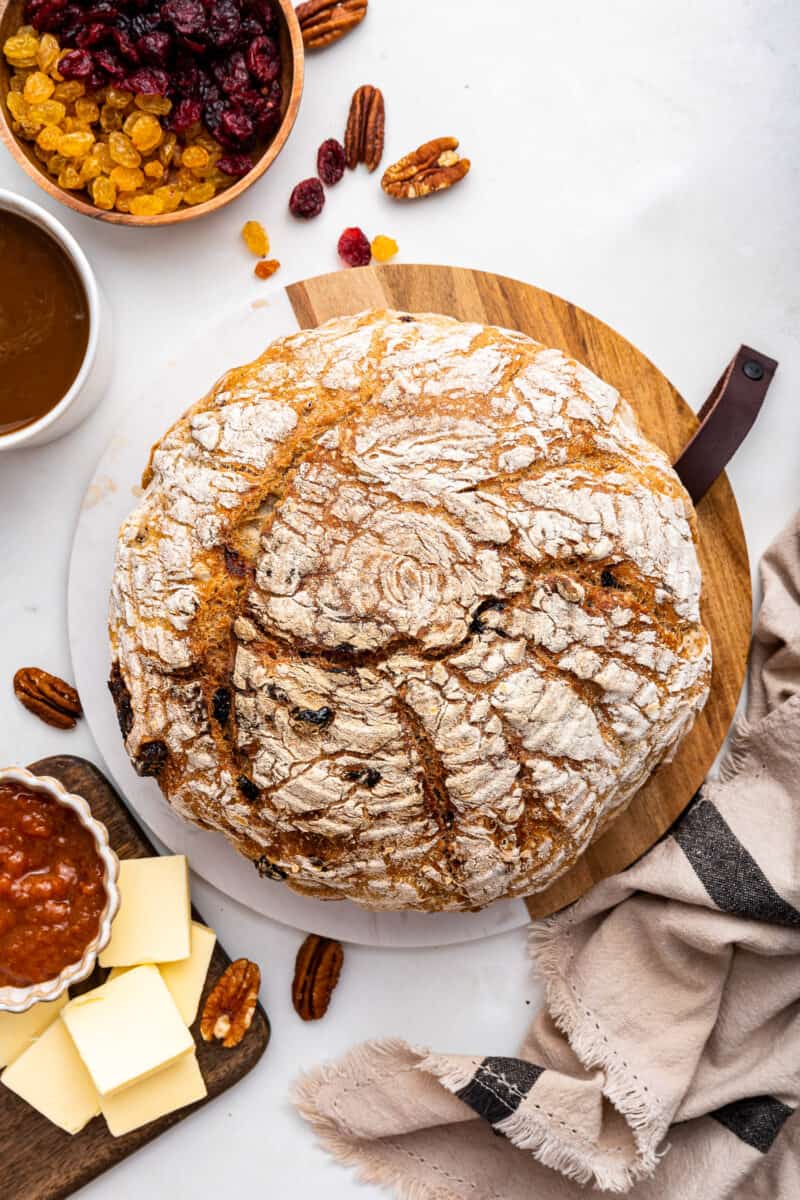
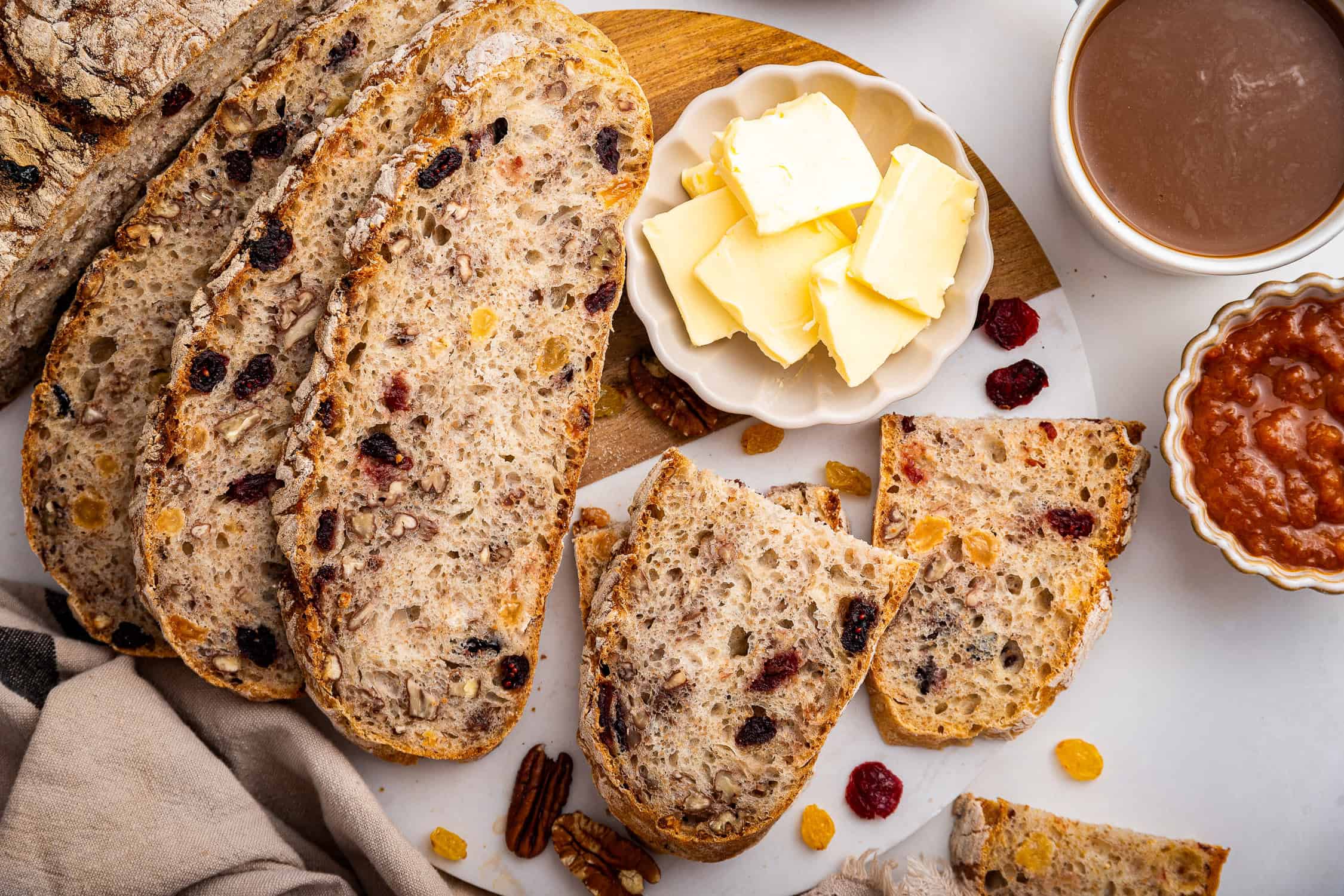
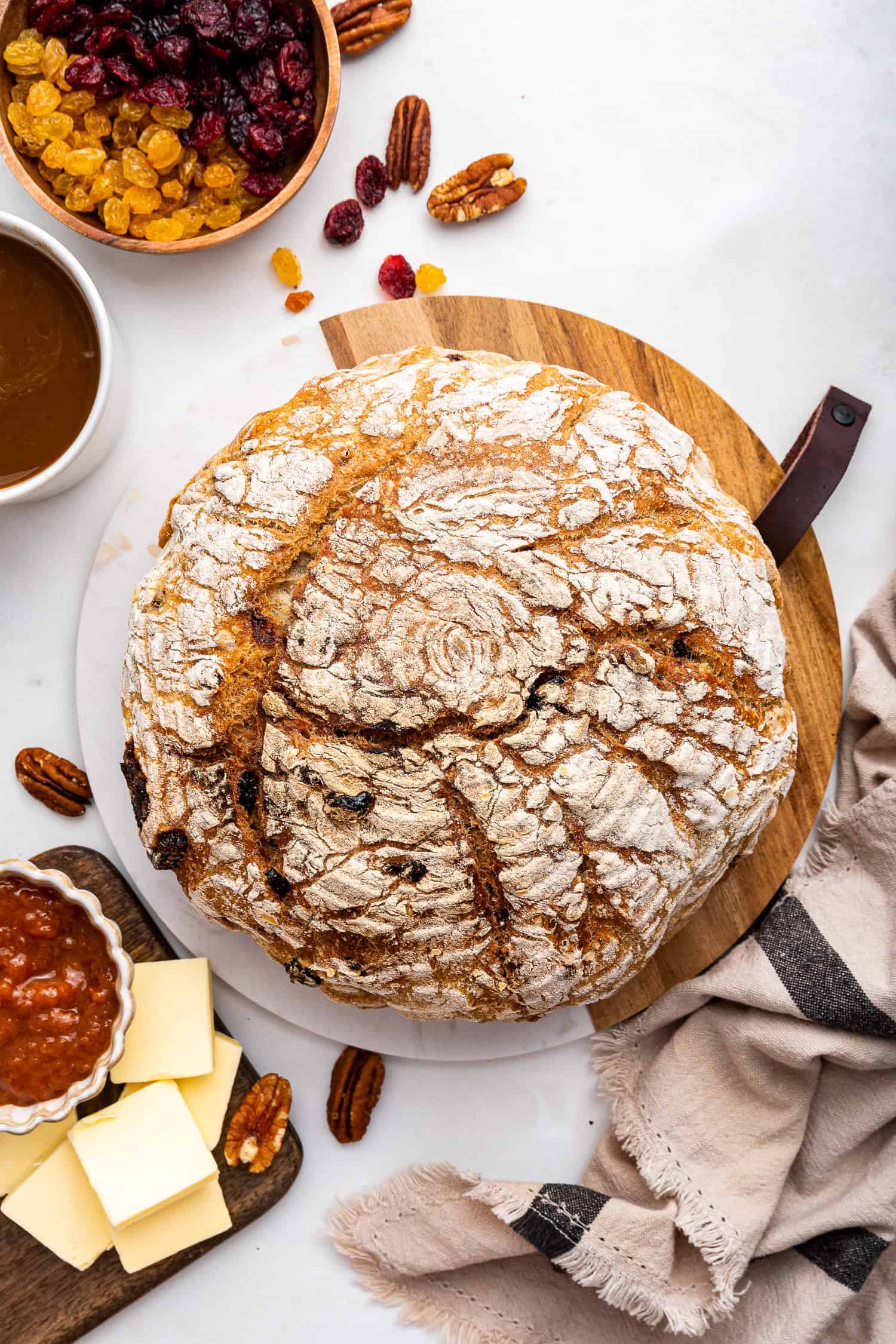
Pull this loaf out of the pot, and it crackles as it cools — a dark, blistered crust giving way to a chewy, open crumb packed with dried cranberries, golden raisins, and toasted pecans. It’s the kind of bread you’d pay eight dollars for at a bakery, and it starts with four ingredients stirred in a bowl the night before.
If you’ve eaten your way through the bread basket at Parc, this is my closest version of the cranberry-walnut loaf. I’ve been making it since 2015, and I still cut the first slice while it’s barely cool enough to handle, with far too much butter on it.
Why Make This?
- Bakery bread from four ingredients. Flour, water, salt, and a half teaspoon of yeast. The fruit and nuts are the only additions, and time does the rest of the work.
- Ten minutes of actual effort. You stir it before bed, shape it in the morning, and bake it. No kneading, no stand mixer, no starter to keep alive.
- The fruit-and-nut combination that converts people. Tart cranberries, sweet golden raisins, toasted pecans — it lands with the people who say they don’t like fruit in bread.
- A yeasted hearth loaf, not a sweet quick bread. Crusty and chewy rather than soft and cakey, and it goes with dinner as easily as it goes with coffee.
- No Dutch oven required. A covered metal roasting pan works, and a stone or steel underneath gives you a little extra spring if you have one.
Ingredient Notes
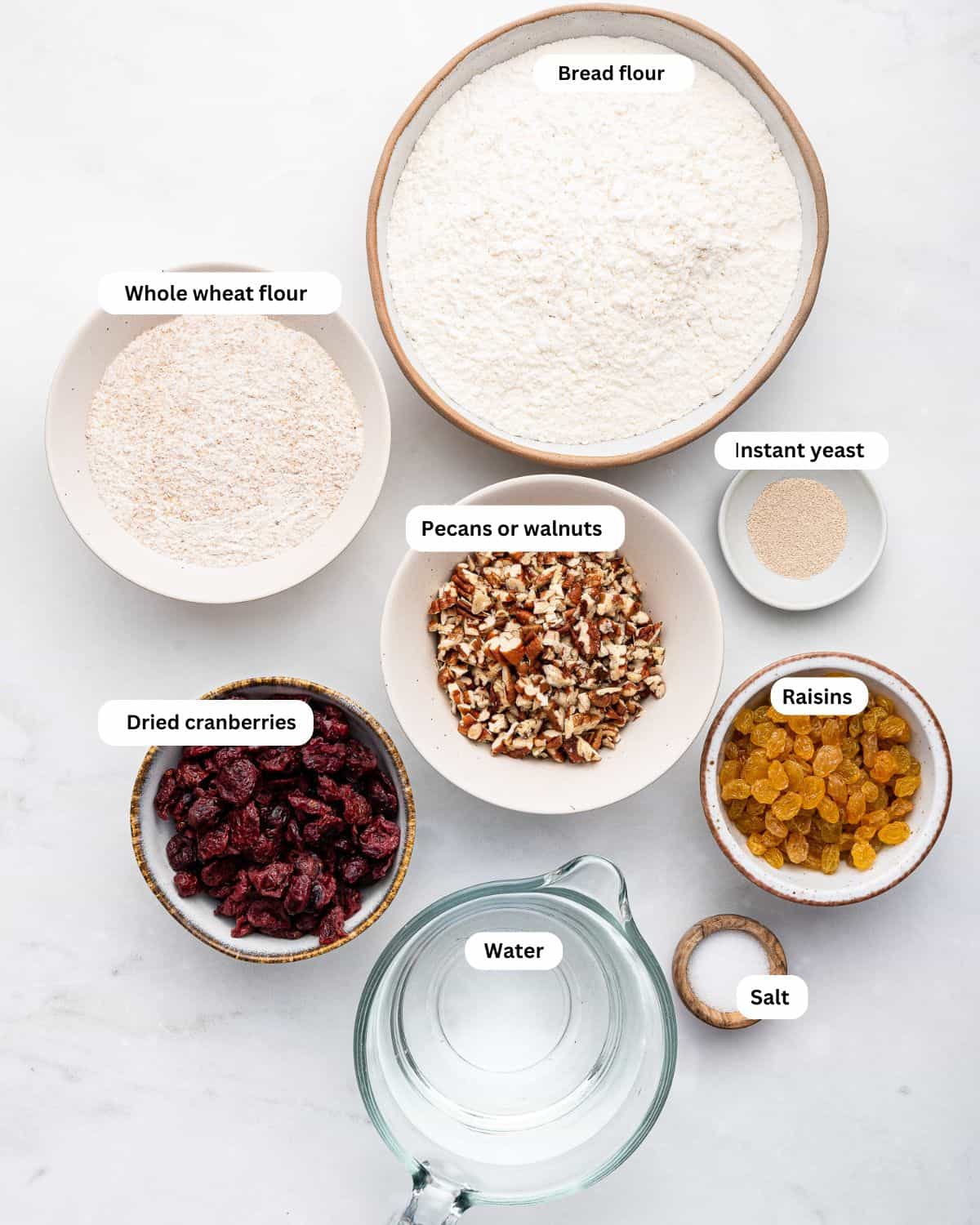
A half teaspoon of yeast, and cool water. This is the whole engine of the recipe, and it’s the part people are most tempted to change. A half teaspoon looks like a mistake next to the two-and-a-quarter you’d use in a normal loaf, and cool water looks like the opposite of what bread wants. Both are there to slow things down. Eight hours of slow fermentation is where the flavor comes from — warm water and a full packet get you a risen loaf in two hours, but it tastes like two hours. If your kitchen runs warm in summer, go cooler on the water rather than shorter on the time.
White whole wheat, not regular whole wheat. You want the wheat flavor without the bitterness. Standard whole wheat has enough tannin to fight the cranberries — it makes the loaf taste faintly sharp against fruit that’s already tart. White whole wheat is milled from a lighter wheat and gives you the same nuttiness with none of that edge. It’s also only a cup against three and a quarter of bread flour, so it’s seasoning the loaf, not building it.
Dried cranberries — and no, don’t soak them. This is the question I get most, and the answer runs against a lot of advice out there. The chewy bites of fruit against the open crumb are the point. Soaked and plumped, they go soft and blend into the bread, and you lose the contrast that makes a slice interesting. They go in straight from the bag. Dried cherries work identically if you’d rather, and they’re less sweet.
Pecans or walnuts, and it genuinely doesn’t matter. Pecans are softer and sweeter; walnuts are more tannic and a little bitter, and both disappear into a loaf with this much fruit in it. Use whichever is open.
Substitution and Variation Ideas
- All-purpose or regular whole wheat instead of white whole wheat — or skip it entirely and use all bread flour for a lighter loaf.
- Dried cherries instead of cranberries — less sweet, and they hold their shape a little better.
- Almonds or hazelnuts instead of pecans — both firmer, so they stay distinct in the crumb.
- Leave nuts untoasted – no time to toast the nuts? They’ll be fine raw — just a little milder.
- A handful of sunflower or pumpkin seeds — add 2 tablespoons with the fruit and nuts.
- Leave the golden raisins out for a straight cranberry-walnut loaf.
Method (Step-by-Step)
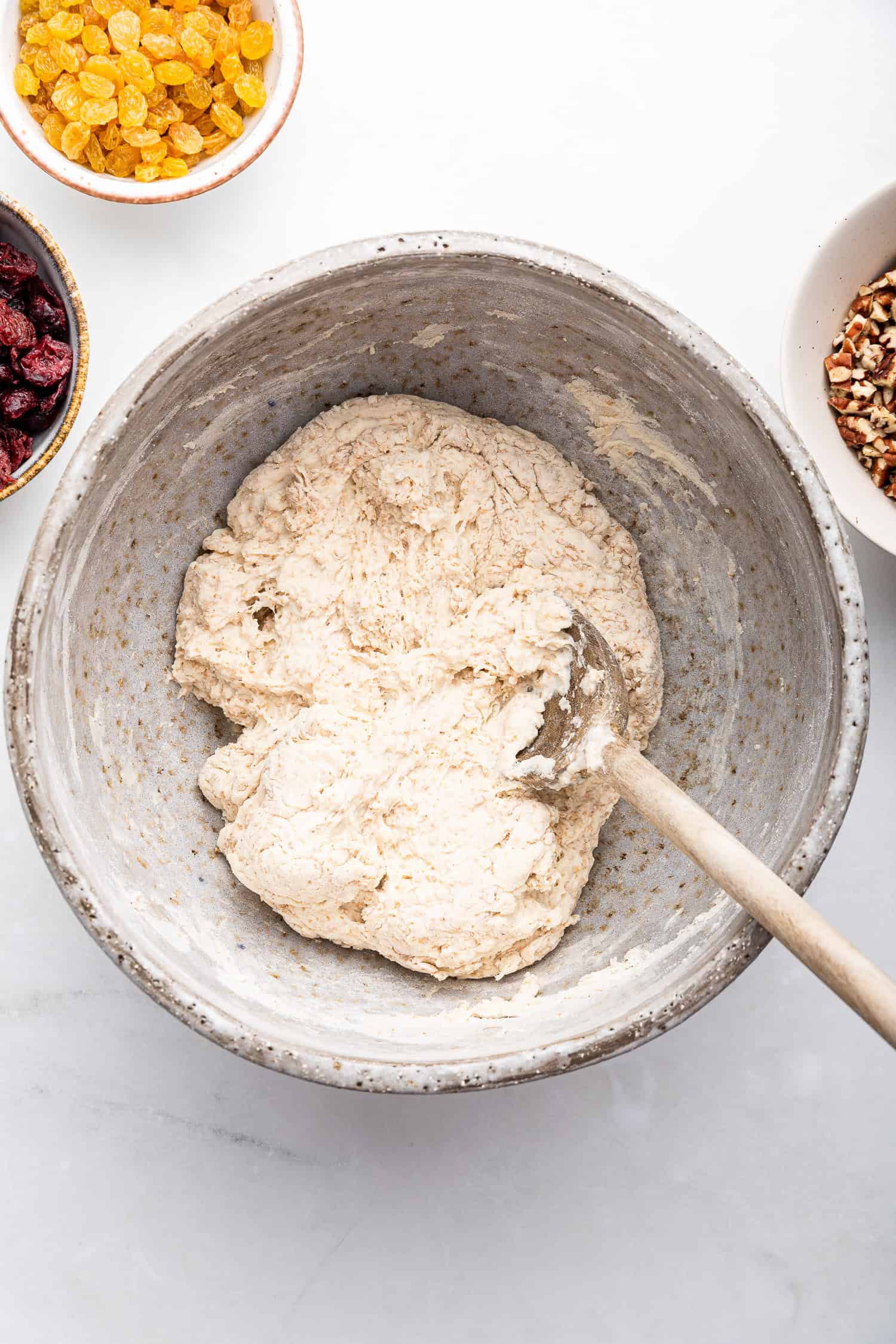
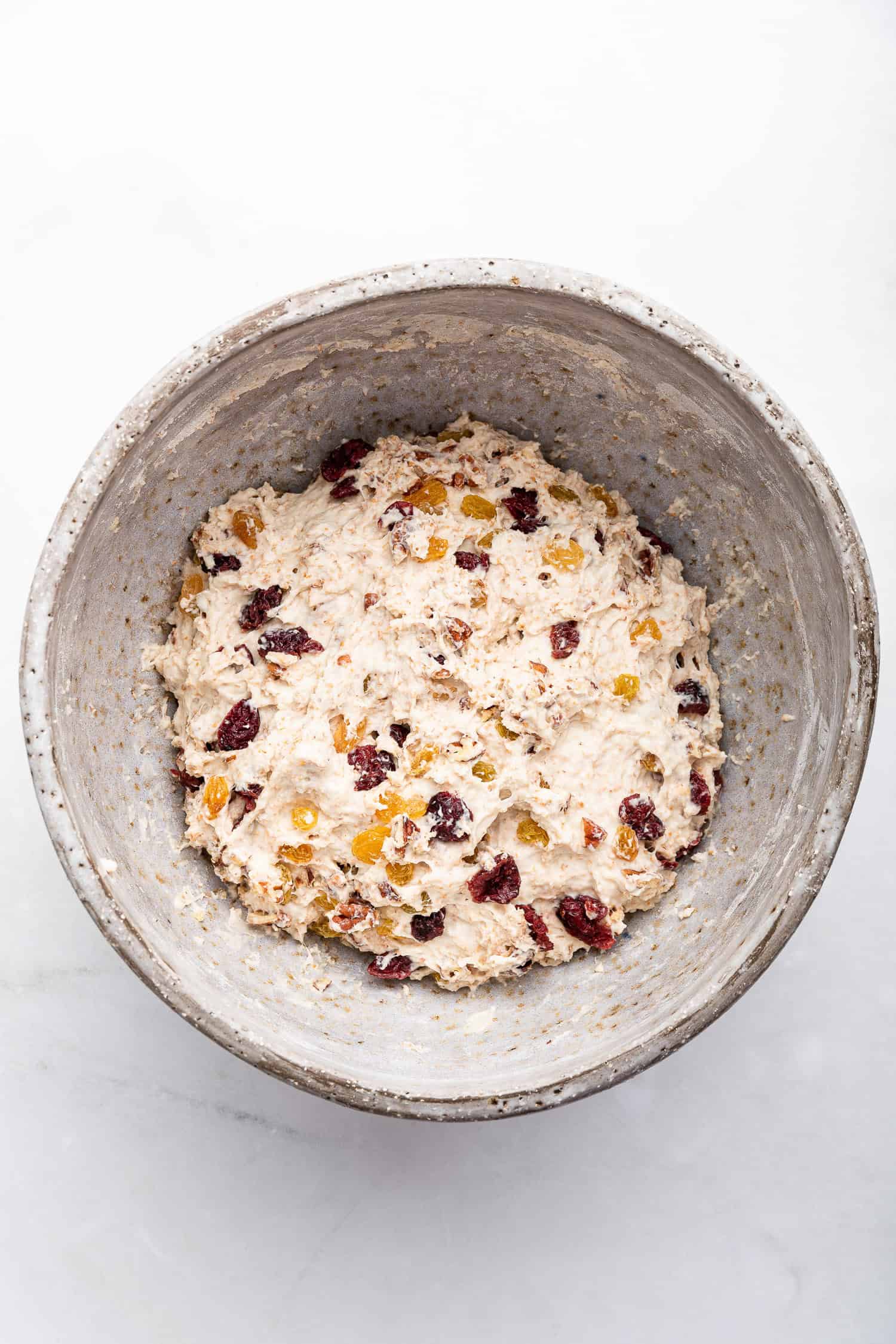
Stir it, don’t work it. You’re mixing until there’s no dry flour left and no lumps — maybe a minute. It’ll look shaggy and wrong, like something you should keep kneading. Leave it. Add the fruit and nuts last — with a cup of extras in the bowl, you can’t tell whether the flour is fully hydrated.
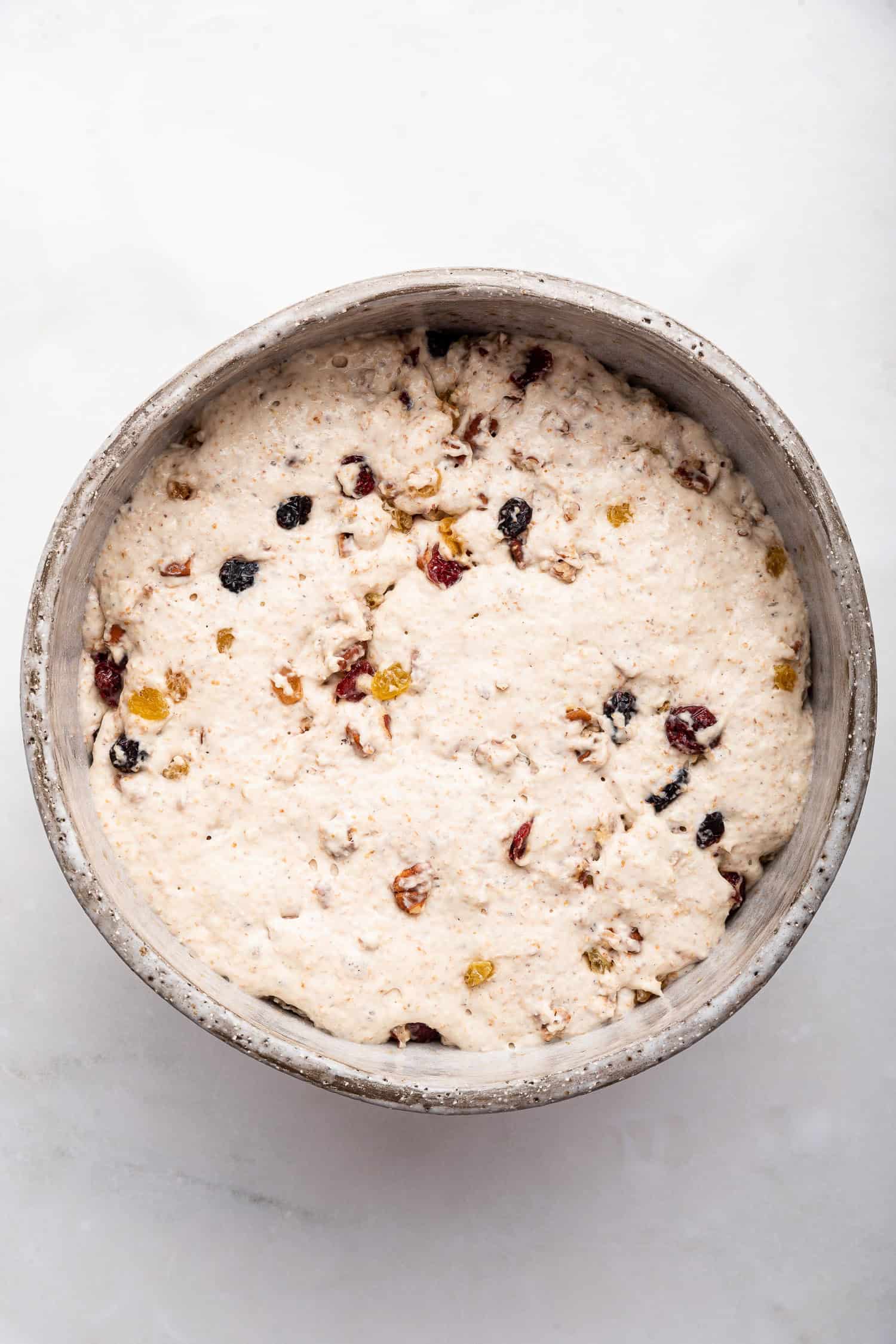
What eight hours looks like. By morning the dough should have roughly doubled, with a domed, bubbly surface and a smell somewhere between beer and bread. If it’s flat and smells like nothing, your kitchen was too cold — give it a few more hours.
Shaping a sticky dough. The dough is wet by design. Flour your hands and the counter, work quickly, and fold it over on itself a few times rather than trying to knead it smooth — you’re shaping it, not degassing it. Place it into the floured bowl seam-side up.
The second rise is shorter than you think. About two hours, but the clock is the less reliable half of it. Press a floured finger into the dough about half an inch: it’s ready when the dent springs back slowly and doesn’t quite fill in all the way. Springs back fast and disappears, it needs more time. Doesn’t move at all, you’ve gone too far — bake it anyway; it’ll just be a flatter loaf.
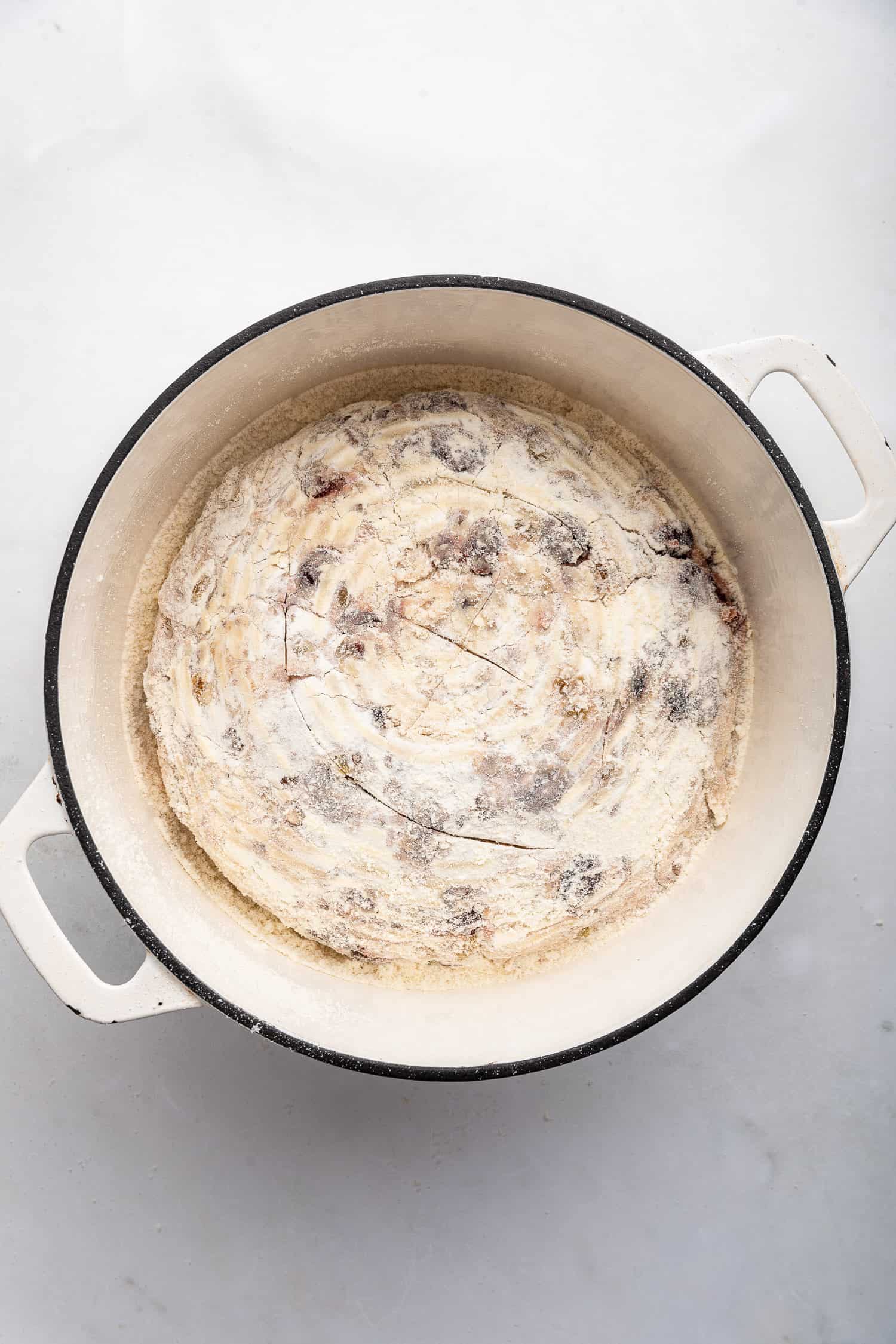
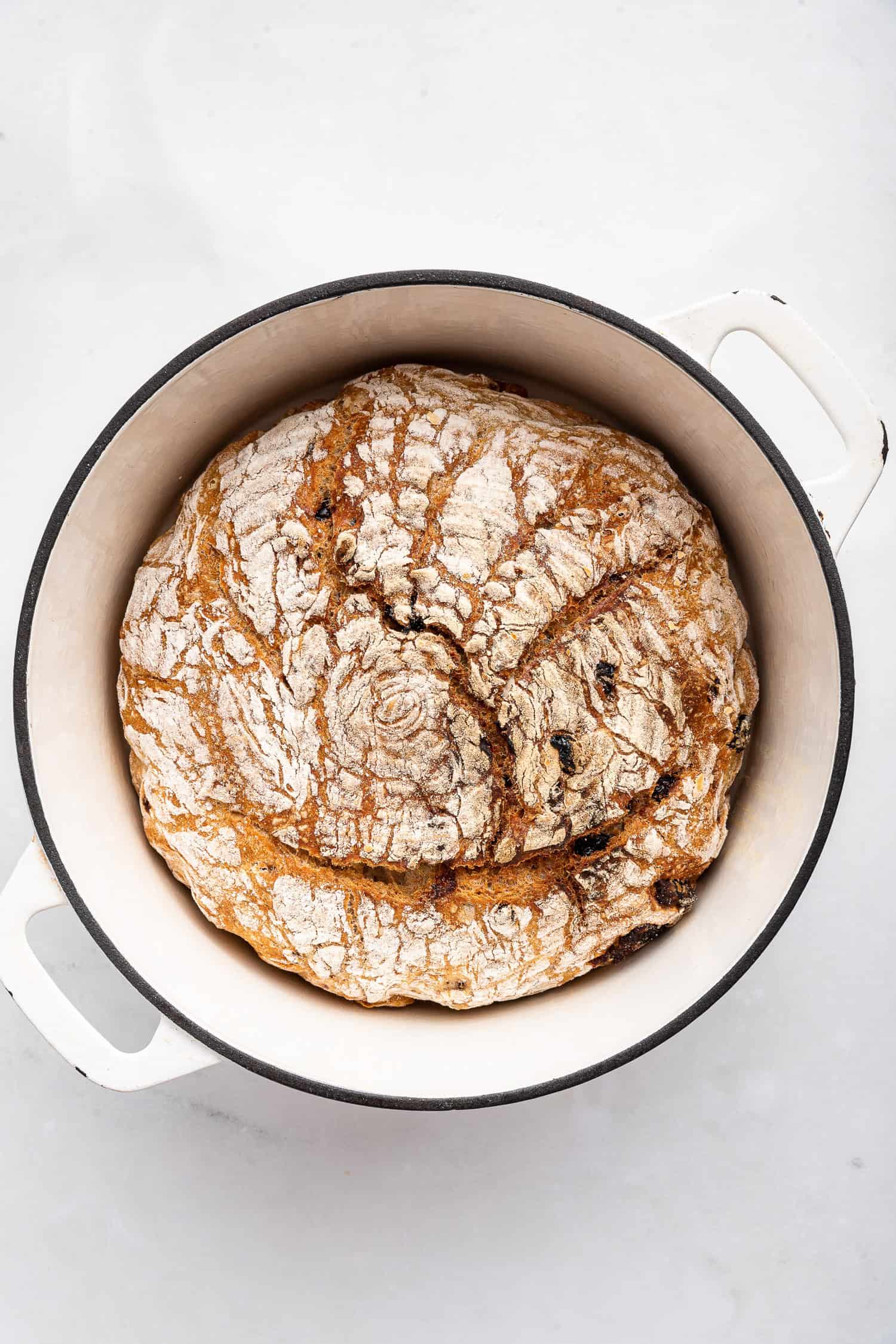
Into the pot. Flip onto parchment seam-side down, score it, lift the whole thing into the preheated pot. Covered for 20 minutes, then uncovered for 30 to 40. Pull it at 205°F in the center — not before, because fruit breads read done on the outside well before the crumb sets. Let it cool before cutting or you risk getting a gummy crumb.
Tips & Techniques
- When in doubt, pull it early. Eight hours is a starting point — a cold January kitchen might want ten or twelve, a hot August one might be ready in six. But underproofed and overproofed aren’t equal risks here. Slightly under, you lose a little volume. Over, the gluten loses its strength, the dough won’t hold a shape, and you pick up a sourness that doesn’t belong in a yeasted loaf. In a warm kitchen, check it at six rather than trusting the eight.
- The second rise is more forgiving than the first. A reader once left hers in the fridge for nearly seven hours and got a beautiful loaf out of it. If your morning gets away from you, cold is the safe place to park the dough.
- Don’t overthink the pot. Anything covered, deep, and wide enough will work — a Dutch oven, a covered metal roasting pan, a casserole with a lid. You’re trapping steam, that’s all.
♥️ Loved this recipe? I’d be thrilled if you’d rate it ⭐️ and share your experience in the comments below! Your ratings and comments help other readers discover this recipe and keep this blog going. Did you add any special tweaks? Our community of home cooks would love to hear about it! ♥️
📖 Recipe

No-Knead Cranberry Nut Bread (Harvest Bread)
Click the heart icon ♡ above to save a recipe. To find your saved recipes later, click the heart icon on the right side of the screen near the search icon and select My Favorites.
Ingredients
- 3 1/4 cups (390 grams) of bread flour
- 1 cup (113 grams) of white whole wheat flour
- 2 teaspoons salt
- 1/2 teaspoon instant yeast
- 1 3/4 cups (397 grams) cool water
- 3/4 cups (92 grams) dried cranberries or cherries
- 1/2 cup (85 grams) golden raisins
- 1 cup (113 grams) coarsely chopped pecans or walnuts toasted
Instructions
To Toast the Nuts
- Toast the nuts for 8 to 10 minutes at 350°F, and then let them cool completely.
To Mix the Dough
- In a large bowl, mix flours, salt, yeast, and water until a sticky dough forms – I like to make sure there are no lumps. Stir in dried fruits and nuts last.
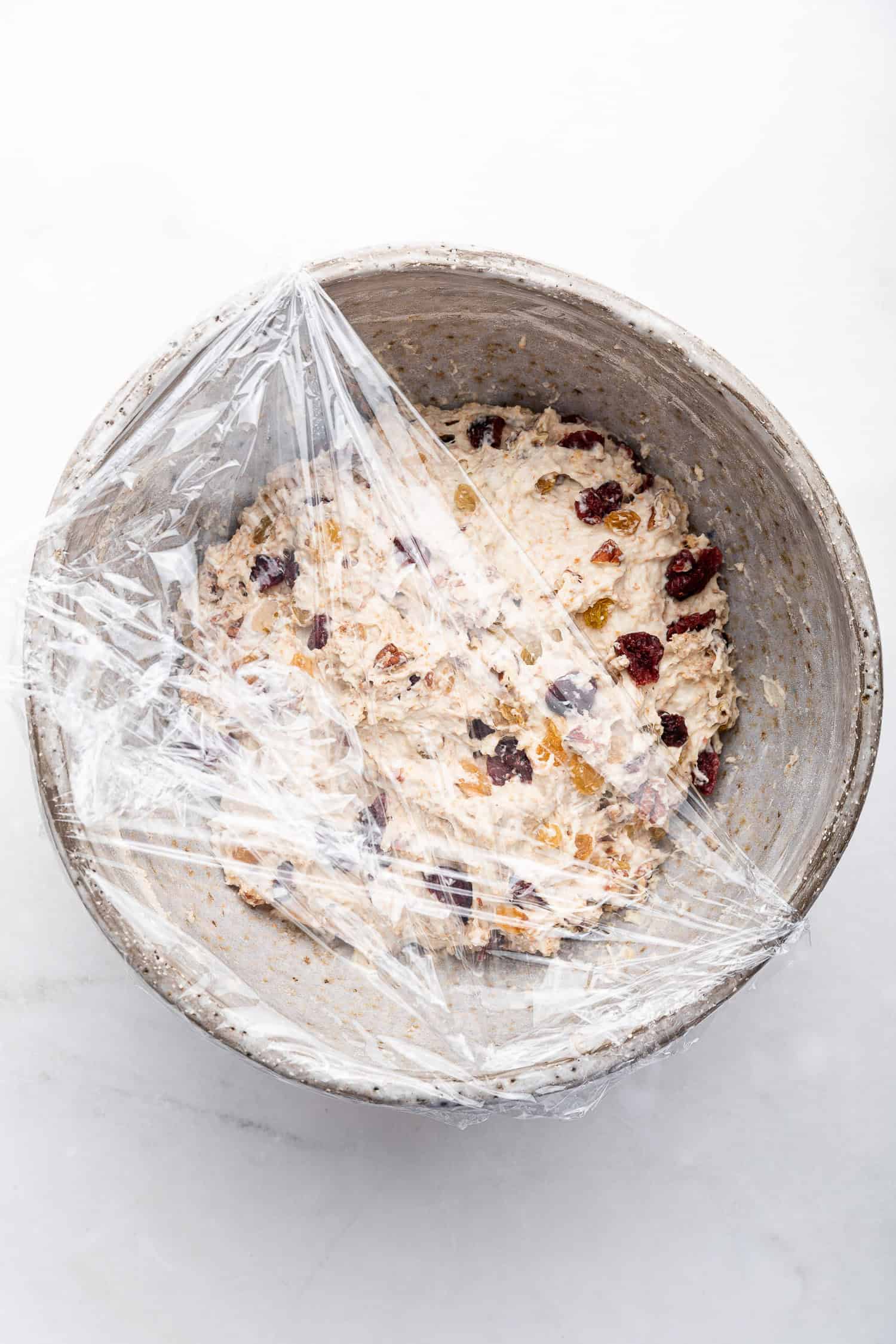
- Cover the bowl with plastic wrap or a large dish and let it rise at room temperature for at least 8 hours or overnight.
To Shape and Bake
- Turn the dough onto a lightly floured surface, shape it into a round or oval loaf, and place it seam-side up in a well-floured bowl. I like to line mine with a well-floured tea towel.
- Let the dough rise for about 2 hours in a draft-free, warm area.
- Preheat the oven to 450°F for at least 30 minutes with a baking stone or steel (or Dutch oven) in the lower rack (see NOTE 1).
- Gently flip the dough onto a long piece of parchment paper, seam side down. Lift the dough with the parchment and place it into the preheated pot.
- Score the top of the loaf with a lame or sharp knife, cover, and bake for 20 minutes. Remove the cover if using a Dutch oven and continue baking for another 30-40 minutes until the loaf reaches an internal temperature of 205°F.
- Let the bread cool completely before slicing.
Notes
Flour Hands: Lightly flour your hands if the dough is sticky.
Shape Gently: Avoid overhandling to preserve air bubbles.
Use Parchment: Transfer dough on parchment; place seam side down in the pot.
Flour Rising Vessel: Flour the vessel well or line with a smooth tea towel to prevent sticking.
Nutrition
Recipe from King Arthur Baking
You said to pre heat the baking stone. Do I take the proofed bread out of the casserole dish and put it on the stone before baking it? If not, what’s the purpose of the stone.
There are a few different ways to do this – I think the easiest is to bake the loaf in a covered metal roasting pan (I use something like this) but you can use any other covered pot that is deep and wide enough. I will typically gently flip my dough onto a piece of parchment and then carefully plop it into the pan. If you place the pan on the baking stone or steel I feel like it helps the loaf spring a bit but I’ve done it without the stone/steel as well.
I made this bread today. It’s absolutely delicious (a bit too delicious!) and my husband, neighbour and I pigged out on it for afternoon tea. I, too, had to leave the dough in the fridge for almost 7 hours for the second proving, but there were no I’ll effects, and it rose beautifully in the oven.
Thank you, Marie, for your generosity in publishing this recipe for us. It’s so easy to make, and just beautiful bread.
Penelope
This looks so nice I’m making it at the moment (it’s on the second rise).
I just couldn’t form a loaf, though: the dough is much too sticky & wet, I had to drop it in a pan (when I turned it on the floured counter, it stuck there!)
Wet dough usually gives great bread, so fingers crossed!
I love this bread!! Hope it comes out well for you
Beautiful, beautiful loaf of bread. Pictures are perfect. You’ve got me craving it. Hmm.
Thanks, Kimberlie! you should try it. So easy and it’s really delish…one of my favorites.