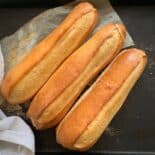
Homemade Hoagie Rolls
Soft hoagie rolls with a thin, tender crust — the Philly-style sandwich rolls you'd get from the bakery, made at home. A long mix and a steamy oven are what give them their chew. Makes 1250 grams of dough: six 6-inch rolls or three 12-inch.
Servings: 6 rolls (small) or 3 large rolls (recipe can be doubled)
Calories: 543kcal
Ingredients
- 6 cups bread flour (see notes for baker's percentages)
- 1 3/4 cups water (room temp/about 70 degrees F)
- 2.5 tsp salt
- 2 tbsp sugar
- 3 tbsp olive oil
- 2 1/4 tsp instant dry yeast
- Note that grams are exact but volume measurements are rounded
Instructions
- Add all ingredients to the bowl of a standing mixer (see blog post for step by step pictures)
- Mix on low speed for 4 minutes (it's important for the flour to "hydrate" and absorb the water before you start using higher speed)
- Increase speed to medium and continue mixing for 15 additional minutes (you want the dough to "windowpane"- this is crucial!) (see notes)
- On a lightly floured surface, roll the dough out to a 12 x 16 rectangle and cut into 6 pieces for small hoagie rolls (6-inch) or 3 pieces for large hoagie rolls (12-inch). Cover with damp towel or oiled plastic wrap and let rest for about 20 to 30 minutes
- Roll each piece out using a rolling pin and after rolling out, roll up each piece jelly roll style and let rest for 20 minutes (this is preshaping - we will do a final shape in the next step).
- After the rolls have rested you will do a final shape. To do so, roll them back and forth on the counter until you have a length of 6-inches for small hoagie rolls or 12 inches for large hoagie rolls. Apply more pressure to ends and pull the dough over to seal the ends if needed.
- Line 2 baking sheets with parchment paper, dust with cornmeal (if using) and place the rolls allowing for about 2 inches of space between. Cover with plastic wrap (I spray the top of my rolls with cooking spray so the plastic wrap won't stick.
- Let the rolls rise for about 60 to 90 minutes at room temperature. (if it's winter and/or chilly, you can place in oven with oven light on; just make sure the oven is not heating/turned on). Alternatively, you can also place the rolls in the refrigerator so they could rise overnight.
- Consider using a "spy" - if you have a small shot glass, add a piece of dough and place a rubber band to mark the top of the dough. When the dough has doubled, it will be easier to see. This "spy" should be subject to the same temperature/location as the rolls that are rising.
To Bake
- About 30 minute before the rolls are finished rising, preheat your oven to 440. Update: do not use convection setting as the fan will dry out the crust and also push out the steam we will create in an upcoming step.
- Just before baking, slash each roll swiftly with a clean razor or knife and then mist with clean water just before loading into oven.
- Mist the oven several times with water or throw a few cups of ice on over floor just after loading bread and quickly close oven door. Try to trap that steam by doing this quickly.
- After about 5 minutes, reduce the oven to 400°F and bake another 10 to 15 minutes — 15 to 20 minutes total from when the rolls went in. Look for a golden color on the crust. You may place the remaining tray in the refrigerator until the first tray is finished baking; don't mist with water until ready to bake.
- If you'd like a glossy look, brush rolls with pasteurized egg whites thinned with a little water or with butter after they are finished baking.
- Hoagie rolls are best eaten the same day; they freeze well. I like to slice and freeze.
Notes
Baker's percentages: flour 100%, water 62%, yeast 1.15%, salt 2%, sugar 3%, oil 5%; small rolls (6-inch, 200 grams dough; 12-inch, 400 grams dough; 9-inch, 300 grams dough)
May 2021: Hydration updated to 62% from 57%.
- To get more accurate cups measurement for bread flour, refer to your flour's nutrition label which will give you grams/cup of flour.
- Use high quality, bread flour - this is the main ingredient in your recipe so make sure it's a good brand
- Use a kitchen scale if you have one. Weighing ingredients is one of the easiest ways to improve your bread baking
- Ensure you are mixing the dough enough initially. This recipe calls for a ~20-minute initial mix
- I also recommend weighing out each dough ball after you portion the dough so that each roll is about the same size
- Make sure the rolls rise enough before baking. The rolls should be at least 30 to 50% larger than when they were first shaped
- If you kitchen is cold, place a pot of water on the stove with the tray of rolls next to it to heat things up
- Using a thermometer such as a Thermapen is very helpful to make sure your dough is not too hot or too cold (target dough temp about 80 degrees after mixing)
- Make sure your oven is hot enough - I found the best place to bake these rolls was right in the center rack of the oven
- Don't forget to mist the rolls with water as well as the oven so you get a bit of oven spring (oven spring is the sudden increase in volume of bread during the first several minutes of baking)
Nutrition
Calories: 543kcal | Carbohydrates: 96g | Protein: 17g | Fat: 9g | Saturated Fat: 1g | Polyunsaturated Fat: 2g | Monounsaturated Fat: 5g | Sodium: 977mg | Potassium: 168mg | Fiber: 4g | Sugar: 4g | Vitamin A: 3IU | Vitamin C: 0.01mg | Calcium: 23mg | Iron: 1mg